
Views: 0 Author: Site Editor Publish Time: 2026-11-09 Origin: Site


Six steps between a felled log and a sealed container — and the two or three places where an order is quietly won or lost.
SENHEDA WOOD · African hardwood since 2009

Packs ready in the yard: strapped, stencilled with the SHD mark, and photographed before loading.
A sawmill is not a factory in the way a furniture plant is a factory. Nothing moves on a conveyor. A log arrives on a truck, is measured by a man with a tape and a piece of chalk, is turned four or five times on a carriage, and leaves as boards that are worth more or less depending on decisions taken in about twenty minutes.
These are the six steps we walk through with buyers who want to know what they are paying for.
1. Raw material selection
Selection starts in the yard. Before anything is cut, the log is read: species, diameter at the small end, length, straightness, the thickness of the sap ring, and how much of the round is sound. A log that is 80 cm at the butt and 55 cm at the top is bought and sold on the 55. Buyers who quote a price off the butt diameter are quoting a log that does not exist.

Log ends marked with lot and number, sealed against checking. The small-end diameter is the one that is priced; the rest is hope.
The ends are sealed as soon as the log is cut, because a log dries from its ends faster than from its sides and a split end wastes the first half metre of every board. Numbers are written on the face: lot, log number, sometimes grade. Those numbers follow the timber through the mill, the kiln and the container, and they are the thread that lets us answer a question six weeks later.
2. Log cutting and processing
The headrig decides how much of the log becomes board and how much becomes sawdust. A thin-kerf bandsaw wastes less wood per cut; a circular saw cuts faster but turns more of the log into dust. On a species that is scarce, the bandsaw usually wins.

Squaring a log on the bench. The first cuts take the sap and the bark; what is left is the part that pays.
The sawyer turns the log between cuts. The first slice takes the bark and the sap; the next opens a face; from there the log is either cut through-and-through, which gives the grading room flexibility, or squared into a cant, which gives wide boards from the middle and side boards from the edges. A 60 cm log can give a 25 cm cant and a stack of side boards, and the split between the two is a commercial decision as much as a technical one.
Cutting to nominal size is easy. Cutting to a size that survives the kiln is the skill: the sawyer leaves enough on the board for shrinkage, and enough on the ends for trimming. A mill that saws too tight looks efficient until the customer measures the dried board.
3. Timber grading
Grading is a language that has to be spoken the same way in the yard and in the buyer's office. Boards are turned and read on both faces: clear, slight defect, defect. Knots, splits, sap, heart, wane and checked ends each move a board down a grade, and the pack is graded as a pack — a stack of good boards with three bad ones on the outside is a grade-two pack.

A graded pack in the shed. Widths are chalked on the ends, the pack carries its own number, and the grade is decided by the worst face, not the best one.
The end of every board is marked with its width, and the pack is labelled with its number, its species and its grade. When a buyer orders grade one, he is buying the top of the stack, not the average of the mill. That distinction is worth more explanation than most suppliers give it, and it prevents most of the arguments that arrive with a container.
4. Air drying and kiln drying
Green timber is not a product. It is a promise that has to be kept in a kiln.
Dried packs under roof, strapped and labelled. The stickers between the boards are not packing; they are the drying system.
Air drying comes first. The boards are stacked with stickers between them — dry, straight sticks at regular spacing, because the sticker is what lets the air move and what keeps the board flat. A pack that is stacked badly will dry unevenly no matter what the kiln does afterwards. Air drying takes weeks, not days, and the roof over the stack matters as much as the wind through it.
The kiln then takes the moisture down to the figure the customer's factory needs — for export furniture work usually somewhere between 8 and 12 per cent, depending on the species and the destination. The schedule is set by species and thickness, and it is run slowly at the start, when the risk of case hardening and surface checking is highest. Every pack is checked with a meter at several points, because a kiln reads the air, not the board.
5. Quality inspection
Inspection is less glamorous than sawing and more useful. An inspector measures thickness at three points on a board, checks moisture with a meter, counts the pack, reads both faces, and photographs the ends and the pack mark. A pack that passes on the tape and fails on the meter is not a pass.

A finished pack: widths chalked, pack number legible, straps tight. This is the state a buyer's inspector should see.
Most of the photographs that matter are taken before the container is sealed. A buyer who receives images of the actual packs, with the numbers visible, can check the shipment against the order without waiting six weeks for a vessel. If an independent inspector is used, his report should travel with the same photographs — not instead of them.
6. Container loading
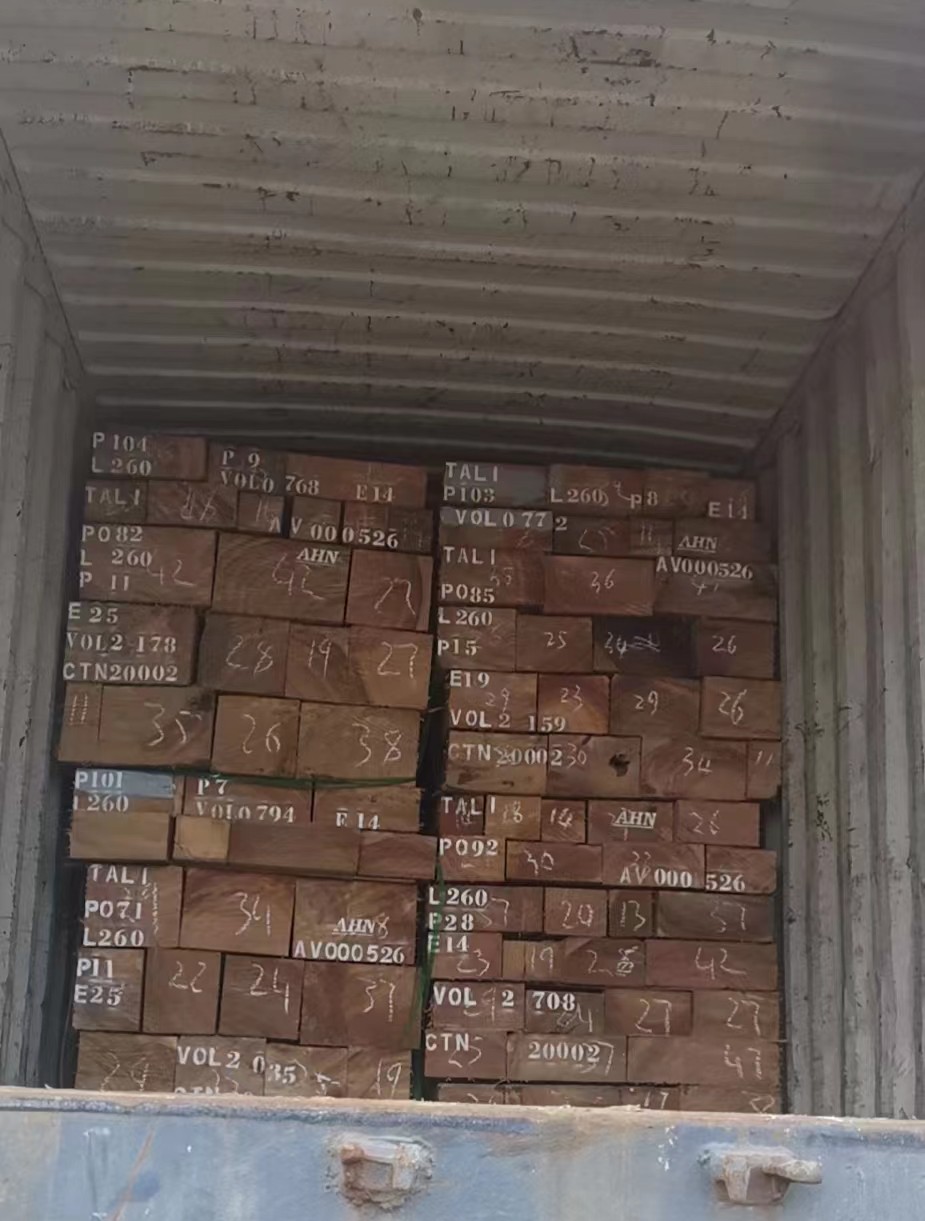
Loading is the last place where money is lost quietly. The packs go in with dunnage against the walls and between the bundles, so that nothing moves when the vessel rolls; the weight is spread along the floor rather than piled at one end; and the door end is packed so that the first thing the buyer sees is the mark he is looking for.

Inside a loaded 40ft: packs braced against the walls, ends facing the door, marks readable at a glance.
A 40ft container takes roughly 27 to 30 cubic metres of sawn timber, depending on pack sizes and how well the bundles fit. The loading list should add up before the door closes, not after. Dunnage must carry the ISPM 15 stamp, the seal number is recorded, and photographs are taken of the container number, the seal and the packs inside. That set of images settles most questions that arrive with a shipment.
Why this matters to a buyer
Every step above is a place where a supplier can save a little money at the buyer's expense: a log bought on the butt diameter, a board sawn too tight, a pack graded on its best face, a kiln run too fast, an inspection that only counts, a container loaded by eye. None of them shows up in a price list. All of them show up at the machine.
We have traded African timber for 17 years. If you want to see how a particular order was cut, dried and packed, ask for the photographs and the loading list — they exist for every container we ship.
Contact: virat@shdwood.com | www.shdtimber.com
WeChat / Zalo +86 17665320128 | WhatsApp +86 17727554471
Photographs from our own mill and yard. Moisture targets, pack sizes and container loads vary by species, thickness and destination; specifications should be confirmed for each order.


