Views: 226 Author: SENHEDA WOOD Publish Time: 2026-06-02 Origin: Site
Kossipo is an African hardwood that is often grouped with other mahogany-like species in the market. It is appreciated for its warm appearance and is sometimes considered an alternative to woods such as Sapele or Sipo in certain applications. Public sources describe it as being used in furniture, cabinetry, flooring, veneer, stairs, and joinery, which already suggests that it is not limited to decorative use alone. It has a broader commercial role in finished wood products.
For door and window manufacturers, that matters. A wood species that already performs well in multiple finished products is easier to trust in production than one that only looks good in theory.
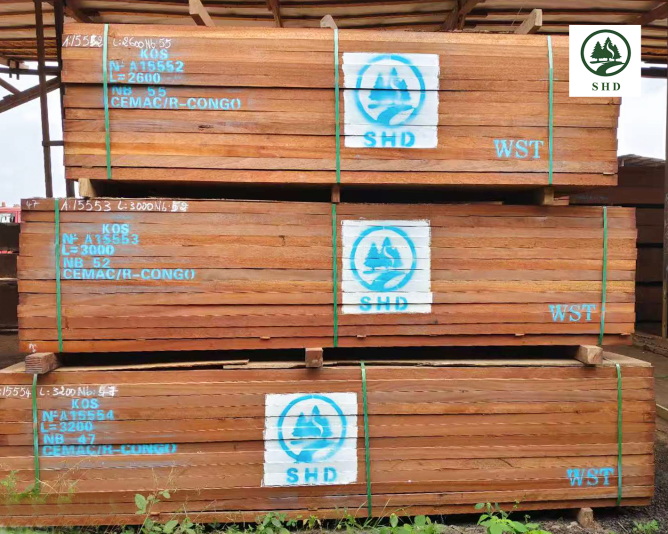
The main reason is simple: it already has an established history in joinery. Public references do not describe Kossipo as a niche or experimental species for this purpose. Instead, they directly list doors, windows, window frames, and exterior joinery among its common uses. That kind of documentation is important for buyers, because it shows that Kossipo has already been accepted in real manufacturing and building applications.
Another reason is that Kossipo is generally considered workable and suitable for machining, which is essential in door and window production. The Wood Database notes that it is overall easy to work, although interlocked grain can sometimes cause tearout during surfacing. It also states that the wood glues, stains, and finishes well, all of which are useful advantages in joinery and frame production.
In practical terms, a door or window frame wood does not just need to be strong. It also needs to machine cleanly, hold shape reasonably well, and accept coatings and finishing systems without too much trouble. Kossipo is attractive because it offers a workable balance of these characteristics.
In many cases, yes. Public technical sheets list Kossipo for exterior joinery, which is one of the clearest signs that it can be used for doors and window frames exposed to outdoor conditions.
That said, buyers should still understand the material realistically. Kossipo is generally described as moderately durable in terms of decay resistance, rather than extremely durable. That means it can work well for many exterior doors, window frames, and related joinery products when the wood is properly dried, machined, sealed, and finished. But it should not automatically be treated as the same kind of timber used for the most extreme outdoor or marine exposure conditions. This is an inference based on the published combination of its moderate durability and its documented use in exterior joinery.
So if the question is whether Kossipo can be used for exterior doors and windows, the answer is yes, in many normal applications it can. But final suitability should still depend on climate, exposure level, finishing system, and production quality.

One reason is its appearance. Buyers looking for a hardwood with a mahogany-like character often consider Kossipo because it fits well into premium door, window, and woodwork product lines. Public sources also indicate that it can be used as a substitute for Sapele or Sipo in some applications, which makes it commercially interesting for suppliers and factories already serving those markets.
Another reason is its application flexibility. A wood species that can be used not only for frames, but also for doors, windows, stairs, flooring, furniture, and veneer, has more commercial value than one that only fits a single product. For buyers and manufacturers, that means Kossipo can support broader product development and more consistent sourcing strategies.
Overall, yes—Kossipo wood is a good choice for doors and window frames, especially when buyers want a hardwood with a proven joinery record, a premium appearance, and good overall workability. Public sources clearly support its use in both interior and exterior joinery, including doors, windows, and frames.
The more complete answer is that Kossipo performs best when it is properly dried, carefully machined, and matched to the right project conditions. For manufacturers, importers, and contractors, it is a practical and commercially credible option rather than just a theoretical alternative wood. And for independent websites, it is also a strong topic because it aligns closely with real buyer search intent: not just “what is Kossipo,” but whether it is actually good for doors and window frames.


