
Views: 226 Author: SENHEDA WOOD Publish Time: 2026-01-12 Origin: Site


Content Menu
● I、In-depth Comparison of Core Performances: Value Positions with Distinct Characteristics
>> 1. Basic Wood Characteristics and Origin Distribution
>> 2. Physical Properties and Durability: Core Game of Stability and Adaptability
>> 3. Processing Performance: Key Differences Adapting to Different Production Needs
● II、Purchasing Recommendations: Focus on Needs and Precisely Match Value
>> 1. Scenarios for Prioritizing Iroko
>> 2. Scenarios for Prioritizing Okoume
>> 3. Balanced Consideration of Cost and Cost-Effectiveness
In the international trade landscape of African hardwoods, Iroko and Okoume have become two major varieties of focus for global purchasers due to their distinct characteristics. The former, known as the "versatile player among African hardwoods", occupies the mid-to-high-end durable scenario market with its excellent decay resistance and structural stability; the latter has become the preferred material in mass production fields by virtue of its outstanding processing adaptability and cost-effectiveness. For furniture manufacturers, architectural decoration enterprises and senior purchasers, accurately grasping the performance boundaries and suitable scenarios of the two is the key to enhancing product competitiveness and controlling procurement costs. Combining SHD WOOD's practical experience in African wood trade for many years, this article conducts an in-depth analysis from core dimensions such as wood characteristics, physical properties, processing adaptability, and application scenarios, providing professional and practical references for industry colleagues.


The performance genes of wood determine its market positioning. The core differences between Iroko and Okoume stem from the differences in wood structure and material composition shaped by their growth environments. Practitioners deeply engaged in African wood trade know that only by understanding these differences from the root can they accurately match needs in procurement and application. The detailed comparison from key dimensions is as follows:
Iroko (scientific name: Milicia excelsa / Milicia regia, commonly known as African Rosewood, Golden Wood) is mainly produced in Nigeria, Ghana, Côte d'Ivoire in West Africa and parts of East Africa. It is a hardwood variety with a long growth cycle in African tropical rainforests. Its heartwood color gradually transitions from light yellowish brown to dark brown, with textures mostly interlaced or wavy, uniform and dense structure, and a warm natural luster. Some high-quality boards will show unique water wave textures. Most notably, Iroko contains natural anti-corrosion components and tannins, which not only have a light woody fragrance, but also can naturally resist termites and wood-destroying fungi, which is the core reason for its durability in outdoor scenarios.

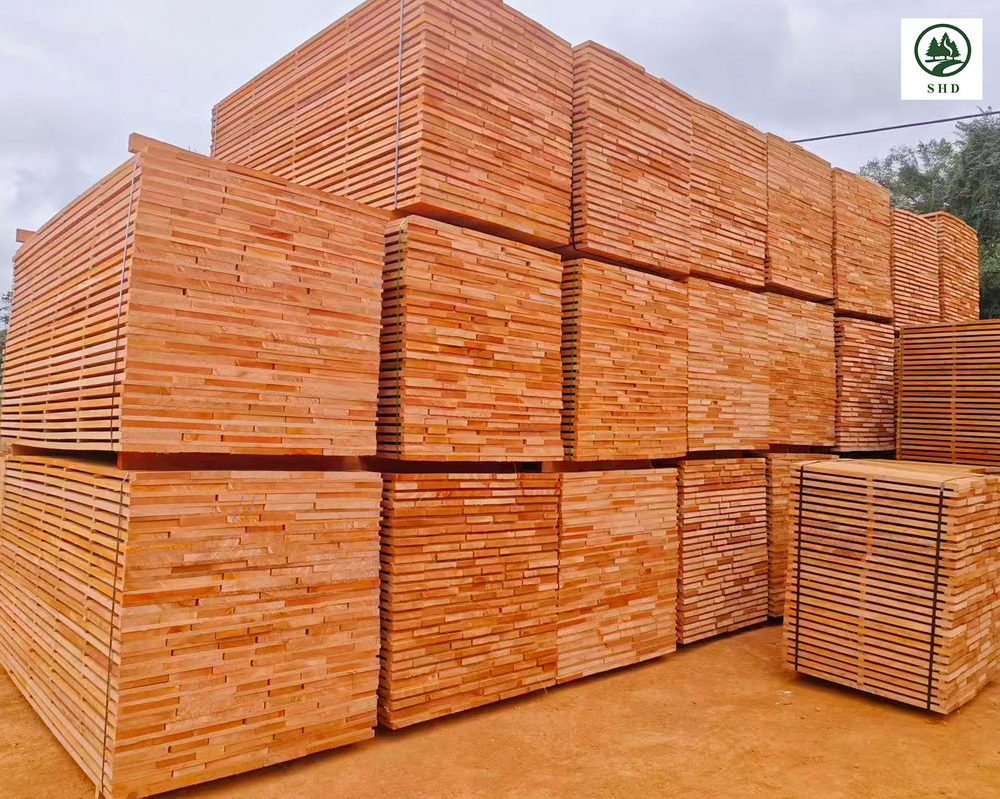
Okoume (scientific name: Aucoumea klaineana, commonly known as Gabon Olive, African Red Sandalwood) has core producing areas concentrated in countries such as Gabon, Equatorial Guinea, and Cameroon in Central and West Africa, and is known as the "King of African Trees". As a typical diffuse-porous wood, its heartwood is bright orange-red to light reddish-brown, sapwood is narrow and grayish-white, texture is mainly straight, structure is fine and uniform, luster is full, and the wood itself has no special odor. More favored by purchasers is that Okoume has extremely small color difference, low knot content, and excellent overall board performance, making it very suitable for mass production with high requirements for appearance uniformity.
Physical properties are the "lifeline" of wood application scenarios, among which air-dry density, shrinkage rate, strength and durability directly determine its application boundary. The air-dry density of Iroko is 0.64-0.77g/cm³, which belongs to medium-density hardwood. Its radial shrinkage rate is about 2.5% and tangential shrinkage rate is about 5.8%, with medium shrinkage performance. Thanks to its dense wood structure and natural anti-corrosion components, after standardized drying treatment, Iroko has extremely strong dimensional stability, is not easy to deform and crack, and its durability can be called "a leader among African hardwoods" — not only does it reach a high decay resistance level, but it can also be used for a long time in outdoor environments with alternating dry and wet conditions without additional complex anti-corrosion treatment. It is one of the few African hardwood varieties that can be directly used outdoors.

The air-dry density of Okoume is 0.48g/cm³, which belongs to the category of light hardwood, with medium-low shrinkage rate, fast drying speed and no easy cracking, deformation and other defects during drying, and good stability after drying. Its flexural strength and hardness are relatively moderate, and its steam bending performance is particularly excellent, suitable for various modeling processes. However, its decay resistance is only "slightly decay-resistant", and its insect resistance is weaker than that of Iroko. It cannot adapt to outdoor humid environments and is more suitable for use in indoor dry environments. If used in indoor areas with high humidity, basic anti-corrosion treatment should be carried out in advance.

Processing performance directly affects production efficiency and product yield. The differences between Iroko and Okoume in this dimension are particularly obvious, adapting to different production modes. The processing performance of Iroko is greatly affected by its wood structure. Due to the certain amount of silicon content, long-term processing will cause certain wear to tools, and it is necessary to grind tools regularly to ensure processing accuracy. However, during sawing and planing, as long as the tools are sharp, smooth processing can be guaranteed; it has good adhesion performance, it is recommended to drill holes in advance before nailing (to avoid wood cracking), and has strong nail-holding power; it has excellent painting and polishing performance, and the surface is smooth and delicate after processing, which can perfectly present its unique texture beauty, suitable for high-end customized processing scenarios.

The processing performance of Okoume can be called "a top student among African hardwoods". Its wood is delicate and straight-grained, and processing processes such as sawing, planing, veneer peeling and carving are extremely smooth. It is especially suitable for plywood veneer peeling and veneer processing, and is one of the core materials for global mid-to-high-end plywood. It should be noted that Okoume also contains a small amount of silica, and long-term mass processing will cause slight wear to tools, but the impact is much smaller than that of Iroko. It has excellent adhesion performance, slightly fuzzy surface, and can obtain excellent coating effect after simple sanding; nailing is convenient and has strong nail-holding power, which is very suitable for standardized mass production scenarios and can effectively improve production efficiency.

Combined with SHD WOOD's years of procurement practical experience, the core of choosing Iroko or Okoume lies in clarifying their own product positioning, application scenarios and budget range. The following are targeted practical suggestions to help purchasers accurately avoid pitfalls and make efficient decisions:
If the procurement demand involves outdoor materials (such as outdoor flooring, landscape planks, dock facilities, outdoor leisure furniture, etc.), Iroko is the first choice. Its natural high decay resistance and insect resistance can greatly reduce later maintenance costs and extend product service life, especially suitable for outdoor projects in humid and rainy areas such as tropical and subtropical regions. In addition, for materials with high requirements for durability and texture in high-end indoor scenarios (such as solid wood flooring in high-end hotels, luxury yacht interiors, load-bearing parts of commercial office furniture, etc.), the stability and unique texture of Iroko can significantly enhance product added value and adapt to high-end market positioning.
When purchasing Iroko, it is necessary to focus on three major quality points: first, check the texture and color. High-quality Iroko heartwood has uniform color, natural transition from light brown to dark brown, clear and orderly interlaced texture, no messy and fuzzy phenomena; second, measure density and dryness. The texture is solid and heavy when touched by hand, and the knocking sound is crisp without dull sound (indicating that the dryness is up to standard, and the water content is controlled at about 12%); third, check for defects. High-quality boards have few defects such as knots and cracks, and no decay or insect infestation marks on the cross-section. It is recommended to choose regular channel sources from core producing areas such as Nigeria and Ghana. SHD WOOD can provide high-quality Iroko directly supplied from the source, ensuring that the wood has undergone standardized drying treatment to avoid later deformation due to excessive water content.

Okoume is more suitable for indoor scenarios and mass production needs, and is a balanced choice of cost-effectiveness and production efficiency. For example, the cabinets, door panels (non-load-bearing parts), drawer side panels of mid-to-high-end solid wood furniture, as well as the substrates of blockboard and multi-layer solid wood panels. Its light weight and convenient processing can effectively improve production efficiency, and its advantages of small color difference and neat texture can ensure the unity of product appearance. In addition, Okoume has excellent veneer peeling performance, and is a core material for mid-to-high-end decorative veneers and plywood, widely used in furniture veneering, indoor decorative panels and other scenarios; at the same time, its good steam bending performance also makes it suitable for scenarios that require modeling processing such as musical instruments (such as guitar panels, violin bodies) and decorative lines.
When purchasing Okoume, it is necessary to focus on two points: first, drying quality. High-quality Okoume has fast drying speed, no warping, cracking and other defects after drying, and stable water content; second, appearance quality. The heartwood color is uniform without obvious color difference, with few knots and most of them are live knots (does not affect the service strength), and the texture is straight. It is recommended to choose sources from major producing areas such as Gabon and Equatorial Guinea. The Okoume wood from these producing areas has a more delicate structure and more stable performance. At the same time, due to its general decay resistance, if it is used in indoor areas with high humidity such as bathrooms and kitchens, anti-corrosion treatment should be carried out in advance, and SHD WOOD can provide targeted pretreatment suggestions.

In terms of market price, the price of Iroko is higher than that of Okoume, but much lower than that of top African hardwoods such as Teak, making it a cost-effective choice in the mid-to-high-end market; Okoume has become an economical choice for mass high-end demand by virtue of its sufficient output and efficient processing performance. During procurement, it is necessary to accurately balance according to product positioning: if the product is positioned high-end, pursues long-term durability and texture, and the budget is relatively sufficient, choosing Iroko can maximize product value; if it is necessary to control costs and pursue mass production efficiency and appearance uniformity, Okoume is a better choice. With the advantage of direct source procurement, SHD WOOD can provide customers with cost-effective Iroko and Okoume resources, and can also provide customized quotation schemes according to the procurement volume and application scenarios.


Iroko and Okoume, as two major popular varieties in African hardwood trade, have no absolute advantages or disadvantages. The core lies in the precise matching with application scenarios and product positioning. Iroko has become a benchmark for outdoor scenarios and high-end indoor durable materials with its excellent durability and structural stability; Okoume occupies an irreplaceable position in the field of indoor mass production and decorative materials by virtue of its excellent processing performance, cost-effectiveness and appearance uniformity.
For purchasers, clearly defining their own demand boundaries is the premise of making correct procurement decisions. SHD WOOD has been deeply engaged in African wood international trade for many years, and has an in-depth understanding of the producing area characteristics, quality control points and market dynamics of core varieties such as Iroko and Okoume. It can provide global customers with high-quality wood resources directly supplied from the source, as well as full-chain customized solutions covering procurement, drying and pretreatment. If you need to further understand the real-time quotation, specification parameters or practical skills of quality identification of specific varieties, please feel free to contact us.


