
Views: 225 Author: SENHEDA WOOD Publish Time: 2026-07-24 Origin: Site


I know a furniture restorer, Mr. Chen, who has been in the trade for over thirty years. He has restored old rosewood from the Ming and Qing dynasties, European walnut, African wenge, as well as all kinds of veneered, composite, and broken laminated furniture. I asked him: which wood is the easiest to restore?
He answered without hesitation: “Teak.”
Why?
“Other woods – when they crack, they’re cracked; when they rot, they’re rotten. You can only patch them or replace them. Teak is different – if it cracks, leave it alone, and the crack will close up by itself. If it gets dirty, a light sanding and the natural oils come back to the surface. It doesn’t get ‘repaired’ – it ‘comes back to life’.”
Mr. Chen‘s words stayed with me for years. Over time I came to understand: teak’s greatest strength is not its hardness, its weight, or its wear resistance – it is the illusion of “self-repair”. In reality, it‘s not repair; it’s the natural oils slowly moving, penetrating, and rebalancing. Other woods get older and look worn; teak gets older and looks richer.
Many teak furniture sellers will tell you: “Teak needs no maintenance – do nothing at all.”
That‘s half true. Teak indeed does not require regular waxing like rosewood, nor does it need to be shielded from humidity changes like ordinary solid wood. Its natural oils are the best protective layer.
But “do nothing” does not mean “abuse it however you like”. I’ve seen someone place a red-hot hotpot directly on a teak tabletop, leaving a white ring – that‘s the wax finish being damaged, not the wood itself. A light sanding brings the oils back to the surface and the white ring disappears. With any other wood, you would have to sand down several millimetres to remove that mark.
What makes teak “hassle-free” is this: it forgives some of your carelessness, and it becomes more beautiful as time passes.
Teak (Tectona grandis) earned its title as “King of Woods” because of its natural oils.
Those oils make teak naturally waterproof, moisture-resistant, termite-proof and fungus-proof. Use it for bathroom cabinets, seaside windows and doors, boat decks – no chemical preservatives needed.
Those oils give teak outstanding dimensional stability. Its shrinkage rate is among the lowest of any commercial timber – meaning it barely cracks or warps with changes in humidity. Whether it‘s winter heating in the north or the humid monsoon in the south, teak stays solid.
Those oils make teak develop a beautiful patina over time. As the surface is touched, wiped and oxidised, the oils slowly emerge, and the colour matures from golden yellow when freshly cut to a warm, deep amber. This is not ageing – it is “ripening”.
Basic reference data:
Air-dry density: 0.55–0.66 g/cm³
Janka hardness: approx. 1,000–1,360 lbf
Natural durability: EN 350 Class 1–2 (very durable to highly durable)
Shrinkage (radial/tangential): approx. 2.5% / 5.8%
CITES status: depends on origin – some populations are listed in Appendix II
If you go to a marina and look at yachts, the decks are almost all teak. Not just because it looks good (though it does), but because teak remains stable under conditions of water immersion, intense sun, and salt spray. Seawater won‘t rot it; blazing sun won’t warp it; crew foot traffic and seawater won‘t make it dangerously slippery.
Using teak in a home is actually a kind of “overkill”. Wood that has withstood typhoons and ocean swells on the sea is more than capable of handling a hot coffee cup and the occasional pet scratch in your living room.
Doors – A villa owner in Guangzhou used teak for his main entrance door. Ten years on, the paint hasn’t peeled, the door hasn‘t sagged, and it still opens and closes quietly. He said: “My friend bought an armoured door for 30,000 yuan, and had to replace the seals after five years. My teak door – nothing but dusting.”
Cabinets – A food blogger’s open kitchen has teak cabinets with light-coloured sintered stone countertops. What surprised her most was that teak actually becomes more lustrous in the greasy kitchen environment. “Every time I wipe the cooktop, I also wipe the cabinet doors – it feels like I‘m polishing the wood.”
Flooring – An elderly couple in Shanghai installed teak flooring when they renovated in the 1990s. Thirty years later, the floor colour has changed from pale gold to deep amber. There are small dents where their children dropped toys when they were young. The wife said: “Those dents are the most valuable memories in this house. A new floor would have no story.”
Table – An independent furniture brand made a three-metre-long tea table from a solid teak slab. They placed it in the prime spot of their showroom, and visitors love to touch it. After five years, the surface has been touched so often it glows like a bronze mirror. The owner said: “This table ‘cultivates’ itself.”
These cases all tell us the same thing: teak is not meant to be placed on a pedestal – it is meant to be used. The longer you use it, the more it becomes yours.

Q1: Is teak still legal to buy today?
A: Yes. Teak is grown in Southeast Asia, West Africa and Central America. Some populations are regulated under CITES Appendix II, and legal trade requires export permits. All the teak we supply comes from legal plantations or sustainably managed forests, with full compliance documentation available. When sourcing, always ask your supplier for origin certificates and compliance documents.
Q2: What is the difference between plantation teak and natural forest teak?
A: Natural forest teak grows for 80–100 years, with higher oil content, darker colour, and more wild grain patterns. Plantation teak (harvested on a 25–30 year rotation) has slightly lower oil content, paler colour, and more regular grain. For the vast majority of furniture, flooring, door and window projects, plantation teak is more than sufficient – and much more affordable.
Q3: What are the disadvantages of teak?
A: Three honest points: first, it is expensive; second, it contains silica, so tools dull quickly – you need tungsten-carbide tooling; third, its colour darkens from golden yellow. If you love that freshly cut light golden hue, you might feel a little regret – but most people find it becomes more beautiful as it darkens.
Q4: Can it be used outdoors? Will it rot?
A: Absolutely. Teak has natural durability Class 1–2 and is highly resistant to seawater and marine borers, which is why it is the first choice for boat decks. Outdoors, it needs no chemical preservatives. The colour will gradually turn silver-grey, but strength and durability do not decline.
Q5: Can you provide FSC certification?
A: Yes. The teak we supply comes from sustainably managed plantations or forestry operations. Depending on the origin, we can provide FSC certification, CITES permits (where applicable), and origin certificates.
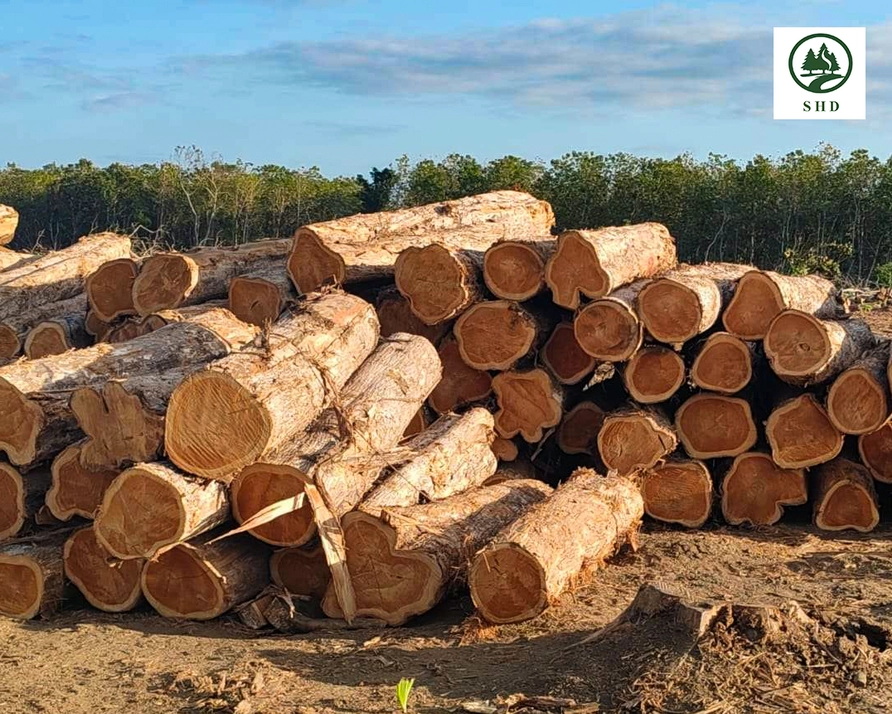
HONG KONG SENHEDA WOOD LIMITED supplies teak logs and FAS-grade kiln-dried lumber directly from source, sourced from compliant origins and meeting international trade standards.
Specifications: thicknesses 25mm, 38mm, 50mm; lengths from 2.4m to 5m+; custom sizes available
Grade: FAS – clear, no knots, no cracks, no heart rot
Drying: slow kiln drying, final moisture content 10–12%
Certifications: depending on origin – FSC, CITES permits, origin certificates, etc.
Inspection: SGS, BV or other third-party inspection at loading port supported
Lead time: 15–20 days for standard specifications after contract confirmation
WhatsApp / WeChat / Call:
+86 13534205619 (Anna Liu)
+86 13530895049 (Vivian)


