
Views: 0 Author: Site Editor Publish Time: 2026-11-27 Origin: Site


From timber grading and dimensional accuracy to moisture content and natural defects, discover the key factors that determine the real value of African hardwood lumber.
Africa is home to some of the world's most valuable tropical hardwood species, including Iroko, Okan, Azobé, Sapele, Tali, Bilinga, and many others.
These timbers are widely used in furniture manufacturing, flooring, decking, construction, marine applications, and industrial woodworking.
However, not all African sawn timber offers the same quality, even when it comes from the same tree species.
Two shipments of Iroko, Okan, or Sapele may look similar at first glance but differ significantly in usable volume, machining performance, dimensional consistency, and overall commercial value.
For international timber importers, understanding these differences is essential.
At SHD Wood (Senheda Wood), we specialize in African hardwoods, South American timber, and plywood products. In this guide, we explain the most important factors that influence the quality of African sawn timber and what buyers should examine before confirming an order.
The first factor influencing sawn timber quality is the wood species itself.
Different African hardwoods have different physical characteristics, including density, hardness, strength, natural durability, grain structure, and dimensional movement.
For example:
l Iroko: Known for its attractive golden-brown appearance and naturally durable heartwood, making it suitable for decking, joinery, and furniture.
l Okan (Denya): A very dense and hard African hardwood, valued for its mechanical strength, wear resistance, and natural durability.
l Azobé (Ekki): An exceptionally heavy and durable timber commonly used in demanding construction and marine environments.
l Sapele: Appreciated for its reddish-brown color, decorative grain, and suitability for furniture and architectural joinery.
l Bilinga: Recognized for its yellow to orange-brown heartwood and use in heavy-duty construction and exterior applications.

These differences demonstrate an important principle:
High-quality timber is not necessarily the hardest, heaviest, or most expensive timber. It is the timber that meets the requirements of its intended application.
For example, a furniture manufacturer may prioritize attractive grain, machining performance, and dimensional stability.
A company purchasing timber for marine construction may focus more heavily on natural durability, mechanical strength, and resistance to demanding environmental conditions.
Therefore, selecting the correct species is the first step toward ensuring timber quality.
Timber grading is one of the most important aspects of international hardwood trading.
It helps buyers and suppliers determine which natural characteristics and defects are acceptable for a particular product.
Depending on the species, country of origin, and trading agreement, sawn timber may be evaluated using recognized grading rules or customized buyer specifications.
For African hardwoods, grading arrangements may reference established tropical timber grading practices, including ATIBT rules.
However, commercial descriptions such as First Quality, Select Grade, or Premium Quality should never replace clear written grading requirements.

Defect | Description | Possible Impact |
Knots | Areas where branches were embedded in the wood | May affect appearance, machining, or strength |
Surface Checks | Small cracks along the timber surface | May reduce appearance quality and usable yield |
End Splits | Cracks extending from the ends of boards | May require trimming and reduce usable length |
Wane | Missing wood or bark along an edge or corner | Reduces usable cross-section |
Sapwood | Outer, generally lighter-colored portion of the wood | May have lower natural durability |
Wormholes | Holes caused by wood-boring insects | May reduce grade or indicate insect activity |
Warp | Bowing, twisting, crooking, or cupping | Creates difficulties during machining and assembly |
Decay | Wood deterioration caused by fungi | May seriously affect structural integrity |

Different customers have different expectations.
For furniture manufacturing, visible knots, cracks, discoloration, or excessive sapwood may be unacceptable.
For industrial applications, certain defects may be permitted if they do not interfere with the intended performance of the wood.
For example, limited sapwood on one corner may be acceptable under a particular rough-sawn timber specification, while another buyer may require practically sapwood-free material.
The key is to define acceptable defects, sizes, quantities, and inspection methods before production or shipment.
One of the most common issues in sawn timber trading is inconsistent dimensions.
Even when timber is sold according to an agreed specification, actual thicknesses, widths, and lengths may vary because of sawing accuracy, natural log shape, or processing methods.
For professional importers, consistent dimensions are essential.
Suppose a buyer orders rough-sawn Okan timber with the following nominal dimensions:
Thickness: 150 mm
Width: 190 mm
Length: 2.1 m
The buyer and supplier must agree whether dimensions are nominal or actual, and whether positive or negative tolerances are permitted.
For example, a specification of 150 mm (+5/−0 mm) × 190 mm (+5/−0 mm) means the finished rough-sawn dimensions must not fall below the stated nominal sizes.
This is particularly important for customers who need sufficient material for additional planing, machining, or resawing.
Another important consideration is the usable length of each board.
Cracks and other defects may occur near the ends of sawn timber.
Some buyers therefore request additional length, commonly called free trim, to allow damaged sections to be removed.
For example, a contract may specify a minimum usable length together with additional free-trim requirements.
Both the measurement method and the relationship between billed length and free-trim allowance should be clearly defined.
High-quality sawing should also minimize excessive taper, uneven edges, and irregular cross-sections.
Properly sawn timber can reduce waste during secondary processing and improve manufacturing efficiency.
For buyers purchasing large quantities, even small dimensional inconsistencies can affect production yield and profitability.

Moisture content is another critical factor affecting the quality and performance of African sawn timber.
Wood naturally contains moisture, and its dimensions can change as it gains or loses water.
If sawn timber is not properly dried or conditioned for its intended use, problems may appear during storage, transportation, or manufacturing.
Two common conditions encountered in international hardwood trading are:
Air-Dried Timber (AD): Timber dried naturally through exposure to circulating air, usually while stacked with spacers.
Kiln-Dried Timber (KD): Timber dried using a controlled process involving temperature, humidity, and airflow.
Kiln drying can achieve more controlled moisture conditions, but the final quality depends on the drying schedule, equipment, species, and timber thickness.
Air drying can also produce suitable material when properly managed.
Inadequate or uneven drying may lead to:
Surface cracking and end splitting
Warping and twisting
Shrinkage after installation
Joint movement in furniture
Reduced dimensional accuracy
Internal drying defects
For furniture and interior joinery, buyers often require lumber dried to a moisture content suitable for the manufacturing environment and final destination.
Exterior and heavy-duty applications may have different requirements.
There is no single moisture-content specification suitable for every African hardwood shipment.
Buyers should specify the target moisture content, acceptable tolerance, testing method, and intended application before placing an order.

The difference between sapwood and heartwood is particularly important when evaluating many African hardwood species.
Sapwood is the outer, generally lighter-colored portion of the tree trunk.
It often has different natural durability characteristics from heartwood.
In some timber species, sapwood is more vulnerable to fungal decay or insect attack.
For applications where natural durability matters, such as exterior decking and marine structures, buyers may require limited sapwood.
For furniture and interior products, excessive color differences between sapwood and heartwood may also affect the finished appearance.
The acceptable amount of sapwood depends on the species, product, and agreed commercial grade.
Some customers may accept limited sapwood on one corner of a rough-sawn board, while others require stricter selection.
This is why sapwood tolerance should be written into the purchase specification, rather than discussed only after the cargo has been produced.
Cracks are among the most frequently discussed quality concerns in hardwood trading.
They can develop during harvesting, sawing, drying, handling, or storage.
Surface checks are cracks that appear on the outside of a board, often following the grain direction.
Small checks may be acceptable for certain industrial grades, but they can be a serious problem for manufacturers requiring clear, decorative surfaces.
End splits develop at the ends of boards and can extend along the grain.
If end splits are too long, manufacturers may need to cut away a significant portion of the timber.
This reduces the actual usable volume.
Some defects are not obvious from external inspection.
Internal checking, also known as honeycombing in some drying situations, may only become visible after resawing or machining.
For valuable hardwood shipments, correct drying procedures and suitable inspection methods are important for limiting these risks.
Buyers should discuss the supplier's sawing, drying, and handling procedures.
Where appropriate, they may also request end sealing, protective storage, additional trim allowances, or independent inspection.
The quality of African sawn timber can deteriorate if it is not handled correctly after processing.
Even well-sawn timber may develop problems during storage and shipping.
Sawn timber should generally be stacked in an organized manner, with suitable supports and spacers when required for drying or ventilation.
Improper stacking can contribute to distortion, uneven drying, and damage.
Exposure to rain, standing water, or excessive humidity can affect timber moisture content and promote staining or biological deterioration.
Storage procedures should be appropriate to the species, drying condition, and intended shipment period.
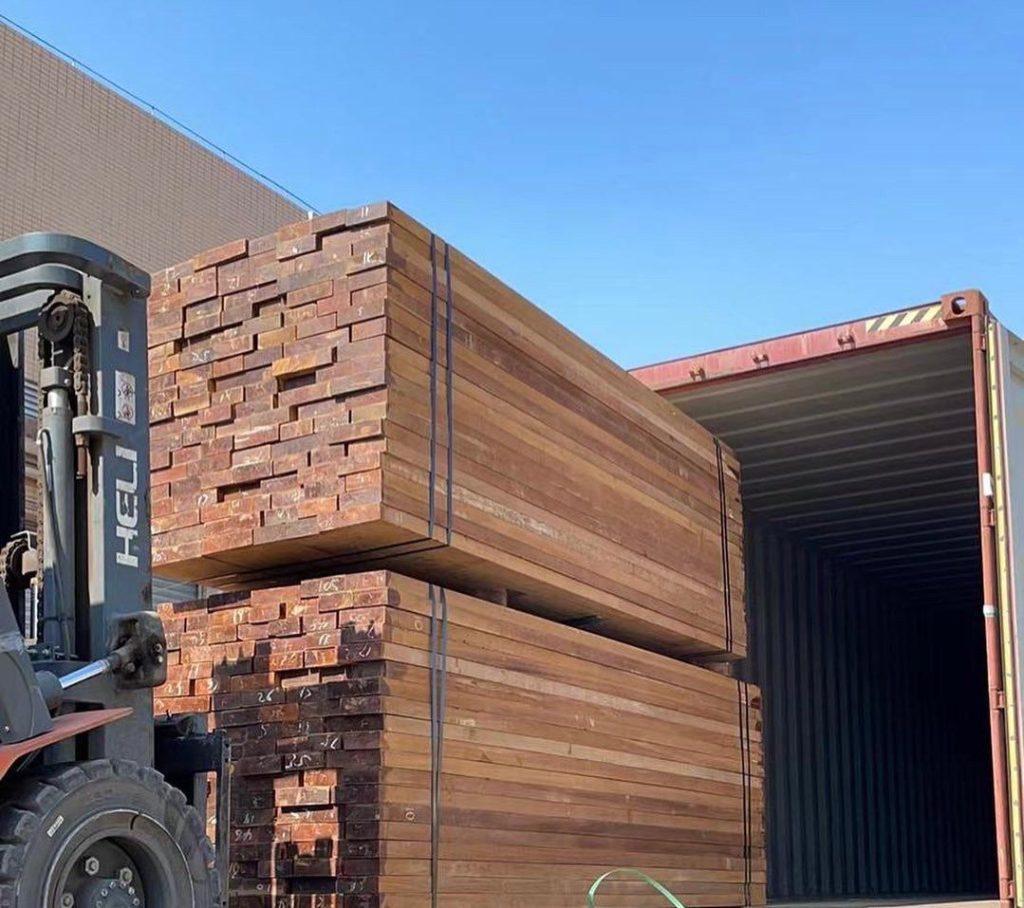
For containerized timber shipments, buyers should consider:
Proper cargo weight distribution
Secure stacking and blocking
Protection against cargo movement
Suitable moisture management
Accurate bundle identification
Clear packing and volume records
Poor loading methods may damage otherwise good-quality timber.
For this reason, packing and shipment procedures are part of overall timber quality management, not merely logistical details.
One of the most overlooked aspects of timber quality is consistency.
A supplier may show excellent sample boards during negotiations, but the delivered shipment may contain significant variation in dimensions, grade, or processing quality.
For commercial timber importers, this creates uncertainty.
Consider a manufacturer purchasing 100 cubic meters of African hardwood lumber.
If most boards meet the required specifications, production can proceed efficiently.
However, if a significant portion contains unacceptable splits, excessive wane, or undersized dimensions, the manufacturer may face higher cutting losses and additional processing costs.
Therefore, the real quality of a shipment should be judged by the entire cargo, not simply a few attractive sample boards.
Before shipment, buyers can request:
Photos showing the overall timber stock
Close-up photographs of representative boards
Dimension measurements
Grade and defect inspection records
A detailed packing list
Container loading photographs
Third-party inspection when appropriate
For larger transactions, an agreed sampling and inspection procedure can help establish whether the shipment complies with contractual specifications.
Not necessarily.
In international timber trading, price is influenced by several factors, including species, log availability, grade, dimensions, processing costs, market conditions, and shipping arrangements.
A more expensive shipment does not automatically provide better value.
For example, a lower-priced timber shipment may become costly if it contains excessive defects or requires substantial trimming.
Similarly, a higher-priced product may offer better processing yield if the material has consistent dimensions and fewer unacceptable defects.

Professional buyers should consider the quantity of usable timber obtained after removing defects and processing the material.
For example:
Item | Shipment A | Shipment B |
Purchased Volume | 100 m³ | 100 m³ |
Illustrative Purchase Price | $600/m³ | $650/m³ |
Usable Yield | 75% | 90% |
Total Purchase Cost | $60,000 | $65,000 |
Usable Volume | 75 m³ | 90 m³ |
Cost per Usable m³ | $800 | $722.22 |
These figures are hypothetical and provided for illustration only. They are not current market quotations.
Although Shipment B has a higher initial price per cubic meter, it offers a lower material cost per usable cubic meter.
This example demonstrates why professional timber buyers should evaluate quality, recovery rate, and total purchasing cost together, rather than focusing exclusively on the quoted price.
Choosing a reliable supplier is just as important as selecting the correct wood species.
A professional timber supplier should understand the relationship between product specifications, grading requirements, inspection procedures, and the customer's intended application.
Before placing an order, buyers should consider several questions.
Different markets may require different dimensions, grades, and acceptable defect tolerances.
A supplier should be able to discuss these details clearly.
Buyers should evaluate the supplier's production capability, quality-control practices, and experience handling international shipments.
The contract should define the species, dimensions, tolerance ranges, grade, sapwood allowance, moisture requirements where applicable, and inspection arrangements.
Commercial invoices, packing lists, shipping documents, and applicable legal-origin documentation should be accurate and consistent with the shipment.
Clear communication helps reduce misunderstandings and allows potential quality issues to be resolved before shipment.
For long-term timber trading relationships, transparency and consistency are essential.
At SHD Wood (Senheda Wood), we specialize in international timber trading, including African hardwoods, South American timber, and plywood products.
We understand that quality requirements vary according to wood species, destination market, and intended application.
Customers purchasing heavy-duty hardwoods such as Okan and Azobé may prioritize strength, durability, dimensional accuracy, and sapwood control.
Furniture manufacturers purchasing species such as Iroko or Sapele may place greater emphasis on appearance, moisture content, and machining quality.
Our approach is to understand each buyer's purchasing requirements and explore suitable timber sourcing opportunities.
Whether you are purchasing African hardwood lumber for construction, manufacturing, furniture production, or distribution, clearly defined quality specifications are essential to successful international trade.
Contact SHD Wood (Senheda Wood) to discuss your African hardwood sourcing requirements.
Please provide the following information:
Required timber species
Thickness, width, and length
Grade and acceptable defects
Sapwood allowance
Drying and moisture requirements, if applicable
Estimated purchasing quantity
Destination country or port
Our team welcomes the opportunity to discuss your timber requirements and potential business cooperation.
SHD Wood (Senheda Wood) — Connecting Global Markets with African and South American Timber.


