
Views: 210 Author: SENHEDA WOOD Publish Time: 2026-07-16 Origin: Site


Last year, a designer making high-end loudspeaker cabinets came to me. He said: “I want a wood that can fade from deep purple to reddish-brown – without any stain.”
I asked him: “Have you ever seen a freshly cut piece of Padouk?”
He shook his head.
I sent him a sample. When he received it, he messaged me: “Is this rosewood? The colour is too bright – doesn’t look like wood at all.”
I replied: “Leave it for two weeks.”
Two weeks later, he messaged again – just one sentence: “It changed colour by itself. From purplish-red to deep cherry-brown, like ripe fruit. I want it.”

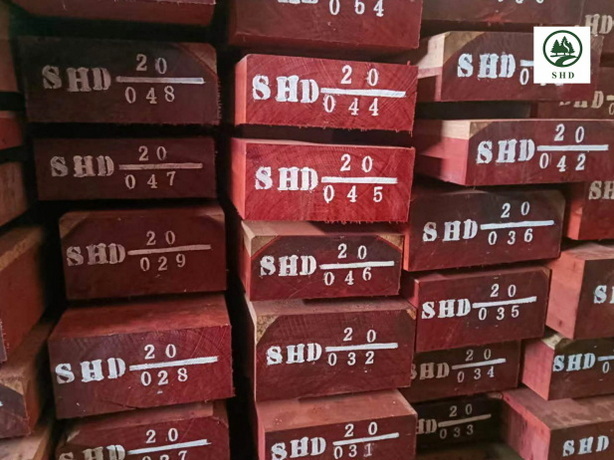
Padouk (also known as African Padauk or Vermillion) – scientific name Pterocarpus soyauxii – comes from the rainforests of Central and West Africa. Its most fascinating feature is that the colour grows.
When first cut, Padouk shows an almost unreal orange-red to purplish-red, as vivid as freshly picked berries. Then, under UV light, it slowly “ripens” – within weeks it deepens to wine red, then purplish-brown, and finally settles into a rich, dark brown with purple undertones. This process is not fading; it is the wood recording time.
No stained timber can ever achieve this kind of dynamic colour evolution.
Its physical properties are equally impressive:
·Air-dry density: 0.67–0.82 g/cm³ (medium-high, solid feel)
·Janka hardness: approx. 1,780–2,100 lbf (harder than ash, much harder than walnut)
·Bending strength: approx. 120–150 MPa
·Natural durability: EN 350 Class 2 (highly durable) – naturally resistant to termites and fungi
·Shrinkage: low to moderate – good dimensional stability
·Workability: relatively uniform grain; glues and finishes very well; contains minor silica, but tool wear is manageable
·Sustainability: Currently not listed in CITES; sustainably managed certification available from some origins
Many buyers treat Padouk as just another hardwood – furniture, flooring, musical instruments – and that is fine. But Padouk‘s real value lies in places that need to be remembered.
For example:
·High-end furniture – A chair made from Padouk darkens with light exposure and the touch of its user over time. That‘s not wear – it’s patina. It‘s the wood aging with you.
·Musical instruments – Electric guitar bodies, bass fingerboards. Premium models from Fender, Gibson and others have used Padouk. Good resonance, and every instrument has a slightly different purplish hue – a natural “signature edition”.
·Outdoor structures – Highly durable. Used for pavilions, boardwalks, garden features – not only long-lasting but also shifting from bright purple-red to a rich, dark brown, as if the building is growing.
·Veneers and inlays – Because of its unique colour, Padouk is often sliced into veneers for luxury yacht interiors, private jet cabins, high-end automotive interiors. Those bold purple figures, curved under light, are stunning.
·Boat decks and heavy flooring – Its high hardness and durability make it suitable for fishing boat decks and industrial heavy-load flooring.
In recent years, some high-end European flooring brands have started heat-treating Padouk (ThermoWood process). After heat treatment, the colour stabilises to a deep purplish-brown to almost black, and no longer changes with light exposure. At the same time, the equilibrium moisture content drops, dimensional stability improves further, and durability increases. If you or your customer need a deep-coloured, premium-looking wood that won‘t suffer colour variation over time – for outdoor decking or interior decoration – heat-treated Padouk is a very attractive option. We can also pre-machine the timber before heat treatment and deliver ready-to-use thermally modified material.
So what did that designer do with Padouk? He made 30 pairs of limited-edition studio monitors. The cabinets are solid Padouk, finished only with clear wood oil. Every pair is slightly different in colour – because every piece of Padouk received a different amount of light. He named the series “Aging”. It is said that the first batch of customers found this note inside the box: “Please place the speakers near natural light. Their colour will change. Be patient.”
Q1: Can the colour of Padouk be stabilised permanently?
A: Not completely. Under natural light, it will always shift from bright purple-red to deep purplish-brown, and eventually to a rich brown. This is its natural character, not a defect. If you want to slow the change, you can apply an outdoor wood oil with UV absorbers. If you need a Padouk that does not change at all with light, choose the heat-treated version – the colour locks into a stable deep purple-brown to black.
Q2: Is Padouk prone to cracking?
A: No. It has low to moderate shrinkage and good dimensional stability. With proper kiln drying (our standard 10–12% MC), cracking risk is very low in normal interior use. For outdoor use, apply a suitable coating and avoid extreme, rapid humidity cycles.
Q3: Any special precautions during processing?
A: Padouk contains only minor silica, so it is easier on tools than Iroko. However, the fine red dust can stain equipment and clothing – good dust extraction is recommended. Gluing and finishing are straightforward and do not require special techniques.
Q4: Can you provide FSC certification?
A: Yes. We source directly from sustainably managed forests in Gabon, Cameroon, Republic of Congo, etc. FSC certification and full origin documentation are available.
Q5: What is the minimum order quantity?
A: We support trial orders of one 20ft or 40ft container. Test it first; then talk about long-term cooperation.
Q6: How does the price compare to teak?
A: Padouk is positioned in the mid-to-high range, typically 30–40% lower than teak, and slightly above Sapele. Given its hardness and unique colour, it offers excellent value.
Q7: Can it be used outdoors? Will it fade?
A: Absolutely. It has natural durability Class 2, highly resistant to decay and insects. Outdoors, the colour will rapidly change from purple-red to deep brown – this is not fading, it is “ripening”. If you cannot accept this change, consider heat-treated Padouk or other outdoor species (Iroko, Azobe).
HONG KONG SENHEDA WOOD LIMITED owns its own factories and long-term concession rights in Congo and Gabon, supplying Padouk logs and FAS-grade kiln-dried lumber directly from source. Standard thicknesses: 25mm, 38mm, 50mm; lengths from 2.4m to 5m+. Lead time: 15–20 days after contract confirmation. SGS/BV pre-shipment inspection supported. FSC certification available. Heat-treated Padouk can also be custom ordered.
WhatsApp / WeChat / Call:
+86 13534205619 (Anna)
+86 13530895049 (Vivian)
www.shdtimber.com


