
Views: 213 Author: SENHEDA WOOD Publish Time: 2026-07-16 Origin: Site


Actual projects of doors, cabinets, flooring, and dining tables made from Myanmar teak
Last week, a customer from Guangzhou sent me a set of photos. They were of his mother‘s renovated old house. The flooring was Myanmar teak laid twenty years ago; the door frames and cabinets were made from the same batch of timber.
In the photos, the floor colour had changed from the original golden yellow to a warm, deep amber. There were some fine scratches on the surface, but not a single plank had warped, cracked or deformed. The door frames were still tight and true.
He wrote one sentence under the pictures:
“My mother says the valuable thing in this house is not the renovation – it’s this floor.”
I looked at that photo for a long time. Not because Myanmar teak is rare, but because of a simple truth: some materials feel expensive when you buy them, but prove their worth over the years of use.

There are two kinds of logic in the timber market. One is “cheap to buy”. The other is “economical to use”.
Myanmar teak belongs to the second.
Its price is indeed not low. FAS-grade Myanmar teak costs three to four times as much as ordinary oak, and twice or more than many African hardwoods. But do the math: a set of teak doors lasts twenty years with nothing more than normal cleaning. An ordinary solid wood door may start to warp, crack or need replacement after seven or eight years. Over twenty years, teak actually works out cheaper.
This is not magic – it is data and experience. Myanmar teak has one of the lowest shrinkage rates of any commercial timber, which means it barely moves with changes in humidity. Its natural oils make it immune to termites and fungi, requiring no chemical preservatives. Its Janka hardness is about 1,000–1,360 lbf – hard, wear-resistant, and the minor marks left by daily use become part of its character over time.
We revisited a group of long-term customers – some had been using teak for nearly twenty years. Here are a few real-life stories:
Doors – A villa owner used Myanmar teak for his main entrance door and all interior doors. Over twenty years, he has changed the lock cylinders twice, but the door leaves themselves are flawless. He said: “My neighbour’s engineered wood doors have been replaced three times in ten years. My teak doors look like new after a wipe.”
Cabinets – A food blogger had her entire kitchen fitted with teak cabinets. She was most surprised that the natural oils in teak actually became more lustrous in the kitchen environment. “After cooking, I just wipe with a damp cloth – the wood surface looks like it has been waxed.”
Flooring – An elderly gentleman in Shanghai chose Myanmar teak flooring when he renovated in the 1990s. Thirty years later, the floor colour has changed from pale gold to deep amber. There are small dents where his children dropped toys when they were young. He said: “Those marks are memories of home. A new floor would have no story.”
Dining table – A furniture brand founder made a long dining table from Myanmar teak and placed it in the centre of his showroom. Five years on, the tabletop has been touched by countless people, had hot coffee cups placed on it, and wine spilled over it. No glass top, no plastic coating – just an occasional wipe with teak oil. That table has become the showroom’s “treasured piece”, its colour warm as aged honey. Visitors often ask first: “Is this table for sale?”
These cases tell us one thing: Myanmar teak is not a consumable – it is an asset.
·Scientific name: Tectona grandis
·Air-dry density: 0.55–0.66 g/cm³ (medium, solid but not overly heavy)
·Janka hardness: approx. 1,000–1,360 lbf
·Shrinkage (radial/tangential): approx. 2.5% / 5.8% (very low, excellent dimensional stability)
·Natural durability: EN 350 Class 1–2 (very durable to highly durable)
·Oil content: high – naturally resistant to termites, fungi and seawater attack
·Workability: contains silica, so tools dull faster; but gluing and finishing are excellent, and it is friendly to traditional woodworking tools
·Sustainability: natural forests of Myanmar teak are now heavily restricted; most material on the market comes from plantation teak, with legal origin documentation and FSC certification available
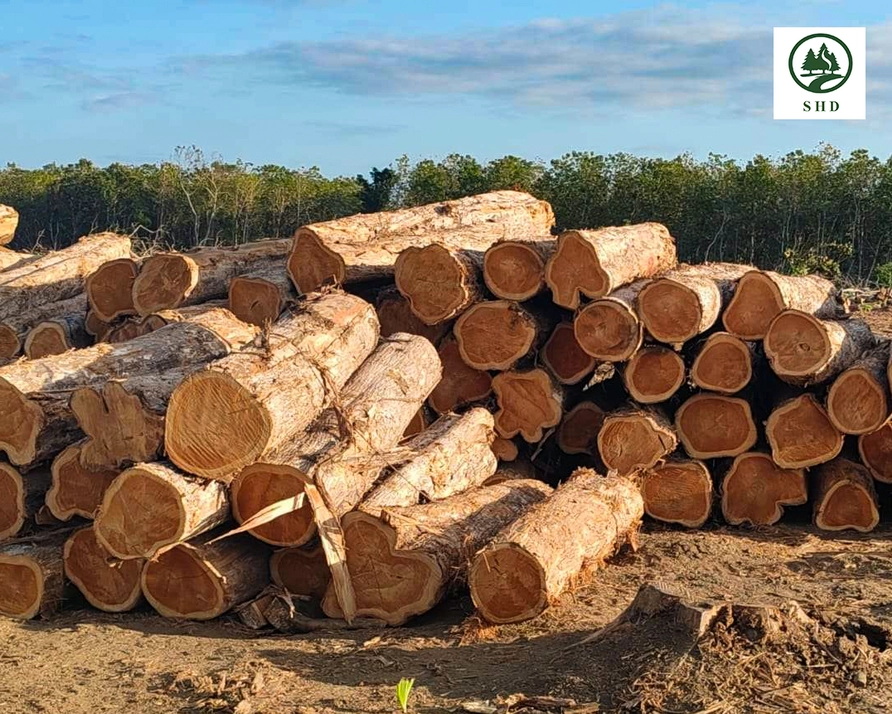
There are plenty of timbers on the market with higher density and greater hardness than teak. Iroko, for example, is harder than teak and costs only two-thirds as much. Azobe is so hard it is used for port quays.
But Myanmar teak has one quality that almost no other timber can match: it is one of the very few woods that combines extreme dimensional stability with natural resistance to rot and insects. Many high-density woods tend to crack; many naturally durable woods require chemical treatment. Teak does not. Its natural oils and tight fibre structure give it both the ability to “stay still” and the ability to “not decay”.
That is why teak is used for century-old ships, historic building restoration, and premium yacht decking. Because it stands the test of time.
Q1: Is Myanmar teak still legal to import?
A: Yes. International trade in Myanmar teak is regulated under CITES Appendix II, and an export permit is required. All the teak we supply comes from legal plantations, with complete CITES export documents and origin certificates. When sourcing, make sure your supplier can provide full compliance documentation.
Q2: Is there a difference between plantation teak and natural forest teak?
A: There is, but not as big as many imagine. Natural forest teak grows for 80–100 years, with higher oil content, deeper colour, and more wild grain patterns. Plantation teak (harvested on a 25–30 year rotation) has slightly lower oil content, paler colour, and more regular grain. In terms of physical performance, both meet the long-term requirements of high-end furniture, flooring, doors and windows. In most cases, plantation teak offers better value for money.
Q3: What are the disadvantages of Myanmar teak?
A: Honestly, three things: first, it is expensive; second, it contains silica, so tools dull faster – you need carbide tooling; third, its colour changes from golden yellow to deep amber over time – some see this as a disadvantage, others as exactly what makes it so attractive.
Q4: Can it be used outdoors? Will it rot?
A: It is excellent for outdoor use. Myanmar teak has natural durability Class 1–2 and is highly resistant to seawater and marine borers, which is why it is a first choice for boat decks. Outdoors, it needs no chemical treatment. The colour will gradually turn silver-grey, but structural strength does not degrade.
Q5: Can you provide FSC certification?
A: Yes. The Myanmar teak we supply comes from sustainably managed plantations, with full FSC certification and CITES export documents available.
HONG KONG SENHEDA WOOD LIMITED supplies Myanmar teak logs and FAS-grade kiln-dried lumber directly from source, all compliant with CITES export standards.
·Specifications: thicknesses 25mm, 38mm, 50mm; lengths from 2.4m to 5m+; custom sizes available
·Grade: FAS – clear, no knots, no cracks, no heart rot
·Drying: slow kiln drying, final moisture content 10–12%
·Certifications: FSC, CITES permit, origin certificate
·Inspection: SGS, BV or other third-party inspection at loading port supported
·Lead time: 15–20 days for standard specifications after contract confirmation
·Supply capacity: dual-source allocation for stable supply
Contact us for the latest stock and quotation for Myanmar teak
WhatsApp / WeChat / Call:
+86 13534205619 (Anna Liu)
+86 13530895049 (Vivian)


